
I blame Guitar Centre
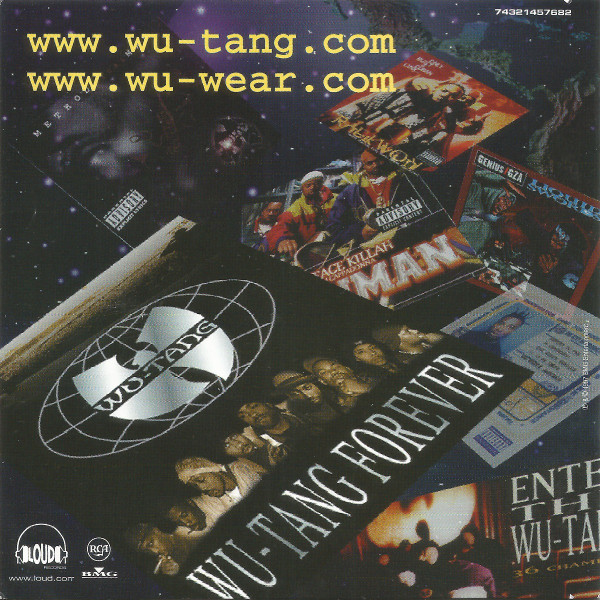
While cleaning out my record shelves and thinking about which records can be sentenced to the consignment crate at the local music shop, I happened upon Wu-Tang Forever. Back when this was released, I thought that that this 4 LP album was 3 LPs too long. Should I ditch it? I have the ‘enhanced’ CD, so I can virtually wander the Wu Mansion in Real Video quality anytime I want. Actually, those clips were the first things I ever uploaded to YouTube, so no need to try and get Macromedia Flash up and running in 2026…
Anyhoo, I’m not a huge fan of this album, seeing as though RZA abandoned his original credo of making offering an alternative to the smoothed-out Chronic era by making the grimiest album possible. No, it’s 1997 and our mans wants to get cinematic and get a live violin player up on this bitch…in LA no less!1 To make matters worse, the original nine dudes (plus Cappa) haven’t hung-out with each others in years (outside of performing onstage), so there’s basically zero rapping chemistry going on outside best buds GFK and Rae.
It’s not a total loss, however, as U-God, Deck and Masta Killa had a lot to prove, not yet being able to release their own records on account of studio floods and record label shite, so they really bust their humps to show-and-prove that they deserve a spot on the team here. Not to mention, Ghost, GZA and Method Man are still at the height of their powers, so even if they aren’t quite as pepped-up, they still deliver some incredible performances.
I was curious to hear more about the behind-the-scenes stories, so checked out S. H. Fernando Jr.’s From the Streets of Shaolin: The Wu-Tang Saga book which provides a very thorough track-by-track breakdown of every album from the original five year run that RZA is always banging on about.
The biggest revelation from this book is how heavily The RZA drew on a small collection of drums, in particular breakbeats from a DJ tool that his engineer had recorded with drummer Ralph Vargas, who had toured with Cameo and New Edition back in the day. Every effin’ third song from this period uses drums from the first two of these Funky Drummer comps!
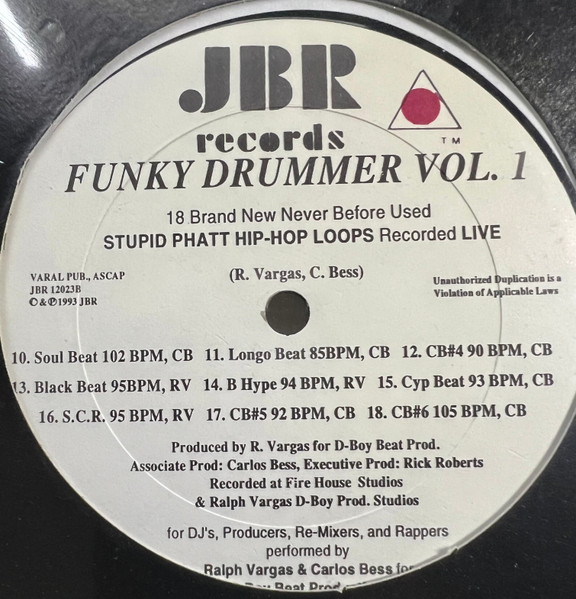
After researching this further, the first two volumes are sessions that he and Carlos Bess recorded (and sold) at Firehouse Studios. These are tributes to classic drum breaks, but re-recorded without any other instruments and run through some samplers and mixing boards, so that they’re crispy clean and ready to chop-up, breakbeat or loop. Ralph performed the drums on the first two, while Carlos released another two volumes with DJ Choco.
For the first two compilations, they ‘covered the snares with t-shirts to create that muffled sound heard on many recordings and even recorded his drumming in the hallway outside of Firehouse’s third floor studio in NYC to capture that area’s natural reverb (echo) on the tracks.’ 2,500 copies were pressed-up for the first volume, and 3,000 for the follow-up.
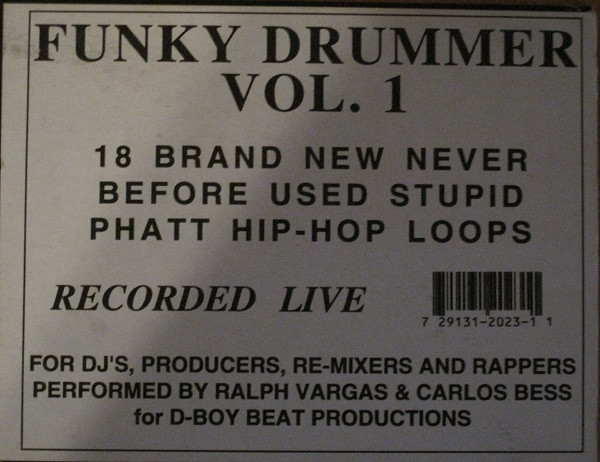
Ralph Vargas later realised that these drums sounds were used on a lot of hit records and attempted to get compensated – but wasn’t that what the Funky Drummer records were for? The sticker on the cover says ‘For DJs, producers, re-mixers and rappers’, which indicates that if you buy this record you can go to town with the sounds.
According to Ralph’s website: ‘The genius behind such successful beats as Bruno Mars’ Just The Way You Are, Dr. Dre’s Xxplosive, Wu-Tang Clan’s 7th Chamber, Ol’ Dirty Bastard’s Brooklyn Zoo, commercials for Sprite, Infiniti, documentaries for MSNBC, and blockbuster movies and TV like; the Netflix series Luke Cage, Limitless and Never Back Down— Da Phunky Drumma helps inspire new sounds and beats that will last for generations’.
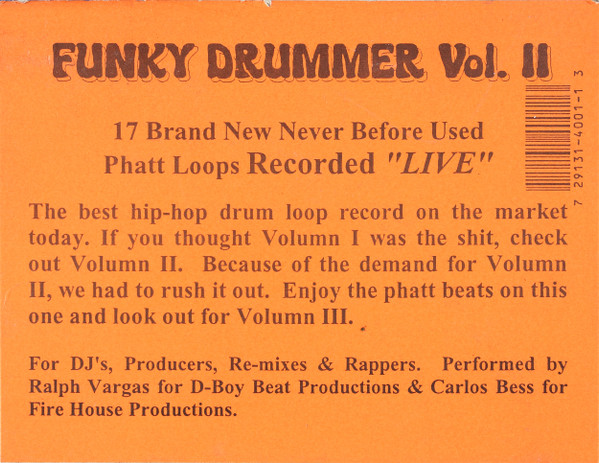
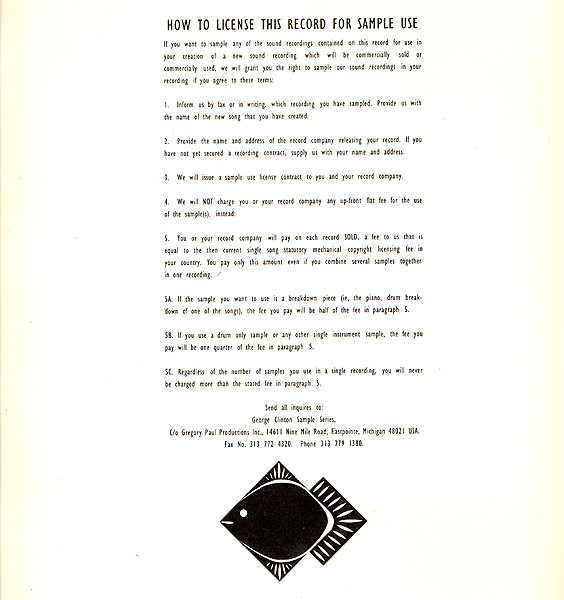
Mr. Vargas concedes that he should have followed in the footsteps of George Clinton’s Sample Some Of Disc Sample Some Of DAT, which included instructions about how to get clearance if you used any of the samples for a commercially released record. Since he didn’t provide any contact information on the Funky Drummer records, he tried to get royalties from these records via the courts but didn’t have the deep pockets needed to go head-to-head with the major labels.
Frequent flyer The RZA eventually agreed to give him some money, as did Bruno Mars, but after he lost a case against electronic producer Brian ‘BT’ Transeau (who used a lot of the beats on his 2002 CD Breakz From the Nu-Skool), Ralph couldn’t afford to keep chasing people.
But back to Wu-Tang Forever… according to S.H.Fernando Jr’s account, once THe RZA hit the west coast he geared-up, in both senses of the word:
‘RZA’s basic setup consisted of an ASR-10, his bread and butter, as well as an MPC1000 drum machine and several keyboards – including a Yamaha V-71, a Nord Lead virtual analog, Roland 2080, and a Novation bass station. Everything was patched into a twenty-four-track Mackie board, and he recorded onto three ADATs, which were basically eight-track tape machines that recorded digitally onto Super-VHS cassettes. He could take these to Ameraycan and dump them onto twenty-four-track two-inch tape. Harding recalls accompanying RZA to the nearest Guitar Center, where they dropped about $10,000 on gear, and then wiring it all up at his hotel room and, later, at his apartment.’
It’s no surprise that RZA was going nuts on new keyboards, since his introduction to the Ensoniq EPS-16+ was the thing that really set things off for his 36 Chamber sound, as he explained to me in 2014:
‘During that period of time, the best beat-making machine was the SP-1200. The other machine that was becoming sorta popular, but not as popular as the SP-1200, was the Ensoniq EPS-16+. Then there was Roland who made a W-30, if you notice a lot of the EPMD/Erick Sermon sound is made with the W-30, which has more bottom bass in it. It’s a keyboard. But the EPS had more sample time and was – to my knowledge – the only one you could actually change the sample rate on. By lowering the sample bit – instead of being at 44 khz or 24 – I put my down to 17.29. The SP-12 12-bit only gave you 2.5 seconds per pad. The EPS, you could put it at 17 or even at 12, but you could spread that out. You could use all 30-45 seconds on one sample, and thus that got rid of the one bar loop and pushed me to the four bar loop.
There was another producer named RNS, who did Shyheim’s first album, he had the EPS but he wanted the SP-1200. So he traded with me for like a month. That was the biggest thing to happen to hip-hop. [laughs] I learned, ‘Wait a minute! I’m more of a piano sampler.’ The drum machine – I program the drums, but when I’m playing music I like to have four or five different sounds across one palette, cos I’m a DJ.’
So the music was covered. In terms of the rapping though? Raekwon discusses the general atmosphere, or lack of, in his book From Staircase to Stage:
‘On a creative level, one issue I saw right away when we got together to start writing was that the guys who had released solo records weren’t as attentive when we got to working. Before, we used to get together and guys couldn’t wait to show off their new rhymes. This time nobody was as hungry to create. More time was spent talking about how much money we were making and going to make than about any songs we were supposed to be working on. RZA saw that and decided that he had to take everybody out of their element to find their focus. So we went off to Los Angeles and checked into the Oakwood Apartments, each in our own place, and we got down to it. This was a far cry from my inspirational journey to Miami with Ghost.’
‘…the lethargic attitude starting coming in. I had a few gems on [Wu-Tang Forever], but I started [losing interest] towards the middle of the album. That verse Ghost got [on ‘Impossible’] like, ‘Call an ambulance/Jamie been shot!’ – why couldn’t I write some shit like that? He not the only one. There were a few brothers on there that were getting it [on that album]. I listen to it in hindsight, knowing where I was at mentally. I’m always so hard on myself, I’m thinking, ‘Damn, I can tell that I’m not interested as I wanted to be when doing that Wu project.’
I would come in, lay a verse, and break out, whereas before I would come in, lay a verse, be like, ‘Yo, I got an idea for a hook.’ Somebody else would be like, ‘I got an idea for a hook. Let’s combine our shit and get it popping.’ It wasn’t like that this time. It was the lifestyle.’
Back to Rae:
‘We got our album done, but we got it done in the scrappiest way. To tell you the truth, for a group that had achieved all that we had, it just made me sad. If we had focused, it would have been an even better album. The chain we had shown the world on Cuban Linx was nearly broken just two years later. When we were in the studio, dudes were questioning each other’s rhymes for personal reasons, not for the sake of the music no more. Dudes would just say another dude’s rhyme was trash right to his face.
It wasn’t constructive, though I know I did it once or twice myself out of frustration. The energy between us just wasn’t right. We got it done, but we were divided on the result just as we were divided on all things at the time: half thought the album was dope, half thought it was trash, and there was no in between. RZA of course had a lot to say, especially to the guys who were critical of the album, since a lot of them hadn’t shown up. And he was right: they had no business saying something wasn’t it if they hadn’t been there to make sure it was.
He was in a tough place, because the album doesn’t sound like anything else he’d done. The production was clean – he was going for a different vibe – and he just expected all of us to trust him on whatever he did. He didn’t really want to hear our opinions at the end of the day. When we heard that finished product, there were a lot of fucking arguments, man.’
The one silver lining is that Loud Records ponied-up a million dollars for the ‘Triumph’ video, featuring a fake Ol’ Dirty Bastard and dodgy CGI bees!
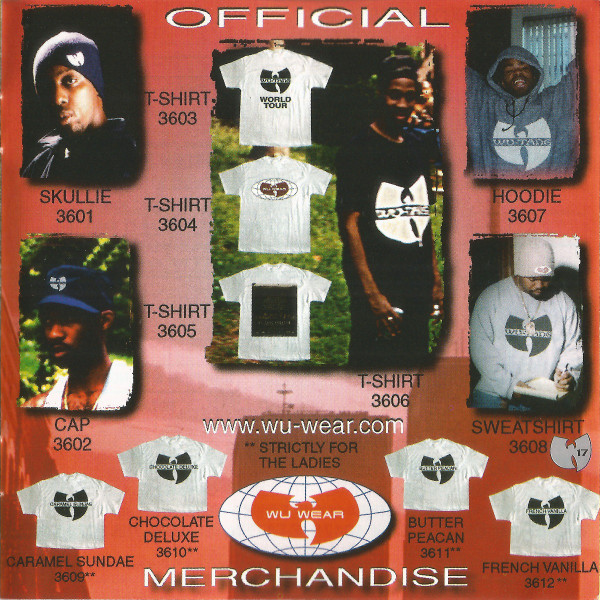
By this stage, the Wu merchandising train was full-steam ahead. The CD included an order form to join a sort of Wu-Tang pyramid scheme where you could potentially ‘rank-up’ by recruiting more members, as well as ads for Wu-Wear products.
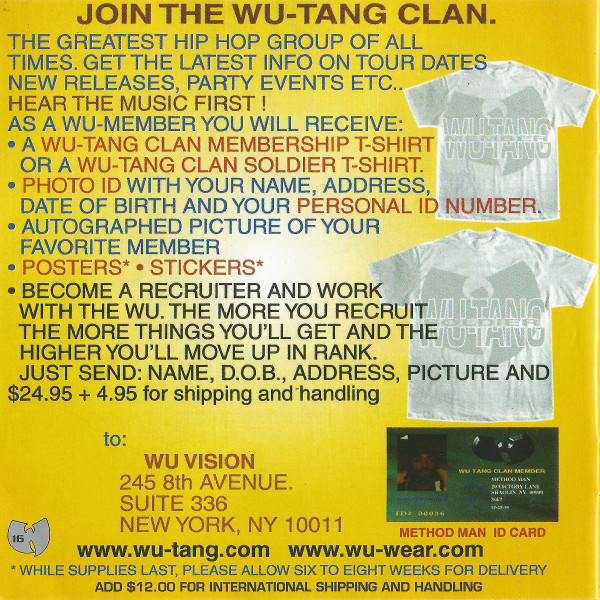
According to Raekwon’s book, Wu-Wear was founded when the original eight members all ‘invested’ forty-thousand bucks with the late Oli ‘Power’ Grant and never saw a cent back (hope they got a couple of shirts at least!).
In terms of how the album holds up now? For my money, ‘For Heavens Sake’, ‘The Projects’, ‘Duck Seazon’ and ‘Heaterz’ are the stand-outs musically, ‘Impossible’ and ‘Triumph’ win on raps alone, while ‘Cash Still Rules/Scary Hours’, ‘As High As Wu Tang Get’ and ‘The M.G.M’ all prime-time Wu-Tang jams. Throw in ‘Older Gods’, which sounds like a left-over Ironman song, and that’s an enjoyable ten track LP.
It’s worth noting that most of my favorites were produced by True Master and 4th Disciple, as RZA begins to focus on a cleaner, modern sound by incorporating live drums from Carlos Bess and going all-out on his collection of synths for lead keys and baselines. This works brilliantly on tracks like ‘Duck Seazon’, but elsewhere it creates a flat, lifeless backdrop to the rapping, as found on ‘It’s Yourz’, which rocks the played-out Gaz breakbeat over some dreary organ. Who chose this as a single by the way? I guess Steve Rifkind ‘must have been sniffin’, indeed. By the time we get to ‘Black Shampoo’ and ‘Second Coming’, RZA is just randomly playing cheesy default keyboard sounds like a kid messing around at Guitar Centre. I guess all those magic mushrooms were really kicking in by that point.
Ironically, this article has become a rambling, unfocused mess by this point, a result of too much time in the oven, and a lack of editing – just like Wu-Tang Forever!
- 1
On a more rational level, I can appreciate that The RZA wasn’t trying to just repeat himself over and over, and was always looking at how he could expand and improve his sound – but anytime I hear keyboard recreations of live instruments on rap records my heart sinks. [↩]
It was a massive disappointment for me at the time. I bought it on vinyl, but after hearing a mate’s CD copy, the vinyl has remained unopened to this day.
For me, RZA only produced three truly amazing albums: Enter the Wu-Tang (36 Chambers), Only Built 4 Cuban Linx…, and Liquid Swords. There are a few others with great moments, but the decline in his mastery was rapid.
Do I own other Wu material? Absolutely. But none of it even comes close to those truly special works of art—though Ironman deserves a special shout-out.
I wish more of “Wu Forever” had resembled “reunited” or “Bells of war.” Then again, I also wish The Rza learned to store his floppy disks somewhere dryer the first time his basement flooded. Then maybe “Tical” wouldn’t have been so mid and we might have actually got Inspectah Deck’s “Peter parkah” album. If ODB had turned up for “Only built for Cuban links Ns…” that would have been the best possible second Wu-Tang Clan album.
I’m all for rappers/producers pursuing the “real musician” dream. But did nobody point out to Rza/Kanye/Muggs that a few piano/guitar lessons are a far better/cheaper way to achieve that dream than hard-drug-fuelled psychosis? I still can’t believe that any of The Rza’s Bobby Digital albums were greenlit for manufacture and release.
The Bess drums were hard to find even into the 2000s. I remember someone on the-breaks forum ripped it for me in wma 160kbps format in 2007. That was the best you could get until somewhat recently. Now every drum library in flac lossless is but a click away. Amongst others, Large Professor used a break off it for “The LP” title track. I can see why RZA would have over-done it at the time, given few people had access to the drums and it was an easy way to stand out, using breaks no one had heard before.
Hi Robbie. I read this fadcinating piece, and contacted my friend Yoram Vazan, who was the owner of Firehouse Studios. Worked on early albums by Wu-Tang, Mobb Deep, Das Efx, MC Lyte, Gang Starr etc. He confirmed the info. Said he pressed around 2000 copies, and they all sold out. Peace.