

This morning I had a quick chat with DJ, producer and record collector Freddy Fresh about B-Boy Records, Breakbeat Lenny, The Rap Records book and the correct storage of 45’s. Freddy’s latest album, Play The Music, is out this March.
Robbie: How did you get involved in remixing a track for BDP’s Man and His Music album?
Freddy Fresh: That was ‘88. My first recorded work was that remix with one button pause switching and broken turntables. That was me hanging out at the offices in the South Bronx of B-Boy Records. The plaque on the Criminal Minded album – there’s a plaque between Kris and Scott – I made that plaque. If you look at the back of the album it says, ‘Freddy Fresh, thanks for the plaque.’ I got name-checked on a lot of those albums – Public Enemy thanked me, MC Lyte, Audio Two – all those guys said ‘thanks Freddy Fresh’ on their album, because I was engraving name plates and sending them out to my favorite hip-hop artists in the Bronx and Brooklyn and stuff in 1985, 6 and 7.
I was making frequent trips – every summer I was in the South Bronx. My father owned a trophy shop and used to be the one who engraved all the trophy plates. I would give DJ’s these plates and then they would give me free records, most of the time. Then I just expanded it and started sending Marley Marl, Red Alert DJ name plates. Just all my favorite DJ’s. I didn’t get to hang out with a lot of them, the only people who I really got to meet was Chep Nunez – cos I was a huge edit fan – and I stayed with Omar Santana at his house. I actually did a couple of 12” singles with Omar Santana on his Tricked Out label. I met Ice-T, I met De La Soul, I met all the people at the record labels in New York of course – Tommy Boy, Profile – I met all those people because I was trying to get promos from them and bring them back to Minnesota.
I would drive to New York, it was a seventeen hour drive. I would be there for at least a month every summer, driving there to get records, hanging out, I networked with people. I worked at a record store called Xanadu Records in the Bronx for a summer, I was selling 12” singles there and just getting paid in records. I would work there for a few hours during the day and when it was time to get money they would just give me any records I wanted. My very first paid gig was in Minnesota, 1983. It was like a disco-style set-up. I would DJ rollar skating rinks and discos. I’ve been deejaying professionally for 32 years.
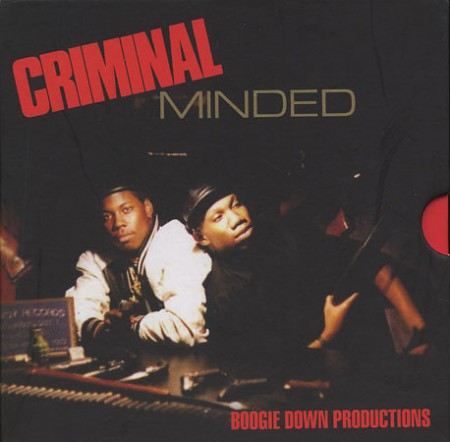
Alternative shot from the Criminal Minded cover shoot with a clearer view of Freddy’s handywork
You also spent some with the legendary Breakbeat Lenny of Ultimate Breaks and Beats fame?
My best memory of Lenny Roberts is him driving me around in the Bronx, talking about records and taking me to Moodies in the Bronx to get [UBB] Volume 8, showing me his store front on Pugsley and sitting there in the offices with him and just talking about music and Ced-Gee. He took me to all the record stores in the Bronx and spent the day with me. Hanging out with him and looking at his collection just reaffirmed that it’s an archaeological dig that never ends. I still find stuff all the time. He put that into practice early, he was digging for beats and finding amazing breaks and starting a cultural lifestyle that I don’t even think he knew was gonna happen. I think he was trying to do cut-out compilations first – looking for funky records – not realizing that a lot of those funky records had breaks on them and rappers started rapping over them. He caught on and took advantage of that really quickly and made sure that the records he put on those compilations had great beats. Lenny would give me the master lists with the name of the artists, and then I would go Minnesota and buy the originals. I’d go and grab the original records and have them first myself.
I’m the one that gave him the nickname The Godfather of Breaks. He was extremely inspirational for me. He used to have a broom handle that went on forever, and it had 45’s on it, and if you wanted to take off one 45 you’d have to take off like a thousand 45’s to get to that one! It was ridiculous, it was no purpose. He had these on the wall, mounted, so there were 45’s everywhere. ‘You can’t get to them like that! Why do you even do that?’ I sent him on a mission to find me some records. I wanted to find Just Four ‘The Games of Life’ on Express Records, and he knew TJ Swann personally and he went into TJ Swann’s neighborhood, and sure enough he found a couple of copies. He calls me up in Minnesota and says, “I’ve got a copy for you, $25.’ $25 in 1986 was lot of money to me, it’s like $100 today. I said, ‘Sure!’ I bought it, and he said, ‘I’ve got another one at $20 if you want.’ I couldn’t do it, I couldn’t buy two! That’s how broke I was.
He had an insane record collection, Biz Markie was gonna buy it. It was about 1995 or ‘96, I got a phonecall from his wife, telling me that he died, and she asked me if I wanted to buy the collection. I thought how horrible it was that he had died and I thought, ‘Of course, I’d love to buy it.’ I’m this stupid young kid, thinking $500 or something, like an idiot! They wanted hundreds of thousands of dollars, it was insanely expensive. There was no way I could have bought it. I found her a buyer, she probably got about 25 grand for it, and off the top of the list I got to cherry-pick what I wanted, so I ended up with a bunch of rare 12”s. That was a karmatic thing that happened – Lenny wanted me to have those records. I dedicated my book to him!
How long did The Rap Records book take to put together?
A lifetime. The revised one is like five times bigger than the first one. Everyone wants me to do another one, but Discogs is out now and it’s not worth doing. I made that book because when I would go to New York city and get my records from my record labels, by the time I’d get back to Minnesota they’d have a new release out that I missed. I got wise to the fact that they had catalogue numbers and it made me mad that there was no way I could find out the catalogues to see what’s coming up. Then I started asking them for catalogue lists, and pretty soon i had all this information and I was like, ‘These needs to be published,’ and then I did the books.
Why do you only cover a certain era in the book?
It was my favorite period, that’s when hip-hop was really alive, the 80’s were the glory days of hip-hop to me. The 90’s hip-hop is funkier and more playable today – a lot of it – but I’m still a big fan of the 80’s hip-hop. Around ‘88 I started falling in love with House music, so I was deejaying and producing House records for Nu Groove in New York and all those labels. Then I got into techno and I lost a lot of really killer 90’s hip-hop, which I later went back and found. When I DJ, I play everything – disco, hip-hop, funk, even Latino beats – everything that’s funky. There’s too much music to just play one groove all night, although I do that too.
When did you move into producing?
I didn’t start releasing music until 1991, and my first release was a hip-hop cut and paste album – B.O.O.M. (Brothers Of Objective Music) on Nu Groove, which is all scratch ups. It’s a pretty rare record. I took my police scanner to the South Bronx and I was recording all these police calls, and I’ve got that on there, it’s just insane. After that I started producing a lot of techno so I wasn’t even thinking about producing hip-hop until I went full circle and became real successful with electronic music and started producing hip-hop again.
I have no vices – I don’t drink, I don’t smoke – my whole life is just digging for beats, looking for rare records, finding and recreating rare disco songs. I have a paradise child’s life of studio and mashing up rare records. I buy and sell to certain elitist groups all over the world for the rare trade – the thousand dollar jazz album or whatever – and deejaying. I also teach DJ techniques at a music college here in the Twin Cities. I wrote the curriculum for dance music production and DJ technique, and I get to teach kids how to scratch and do tricks, so I’m a really lucky guy.
I had toured for seventeen years on the road in Europe, Asia, South America and Canada. I was in Colombia performing and I met a woman there, she wasn’t even in the clubs. I speak fluent Spanish so I stayed in Bogeta and I ended up marrying this woman. She came back here and we had two little girls, who are now three and five, so I said, ‘It’s not conducive to a happy family life if I hit the tours again while we have babies in the house. Let me chill for a while and dig for beats.’ We’ve got some of the best digging places in the world here, so I’m finding all these rare Stax records and these insane records, so I said, ‘Maybe I should teach at music college.’ I don’t have a college education, but because of my history and my knowledge of music they let me do it.
Do you still have any holy grail records that you’re looking for?
Most of the records I’ve wanted I’ve been able to get at one time or another. I wanted ‘Growing Up’ by the Heartbeat Brothers on Elite from the Bronx. It’s not a giant grail, but to me it’s a grail. It’s about a $300 record. I’ve had some of the rarest disco records, I sold a lot of my rare records to DJ Shadow and Cut Chemist buys from me. A lot of diggers all over the world buy records from me. I’ve always been fortunate enough to have most of the ones I’ve always wanted.
dope
peace
Another banger, Robbie, but it’s spelled “Colombia,” with an “a,” not “Columbia.” That always drives me nuts!
@Carlos: Fixed, thanks for pointing that out.